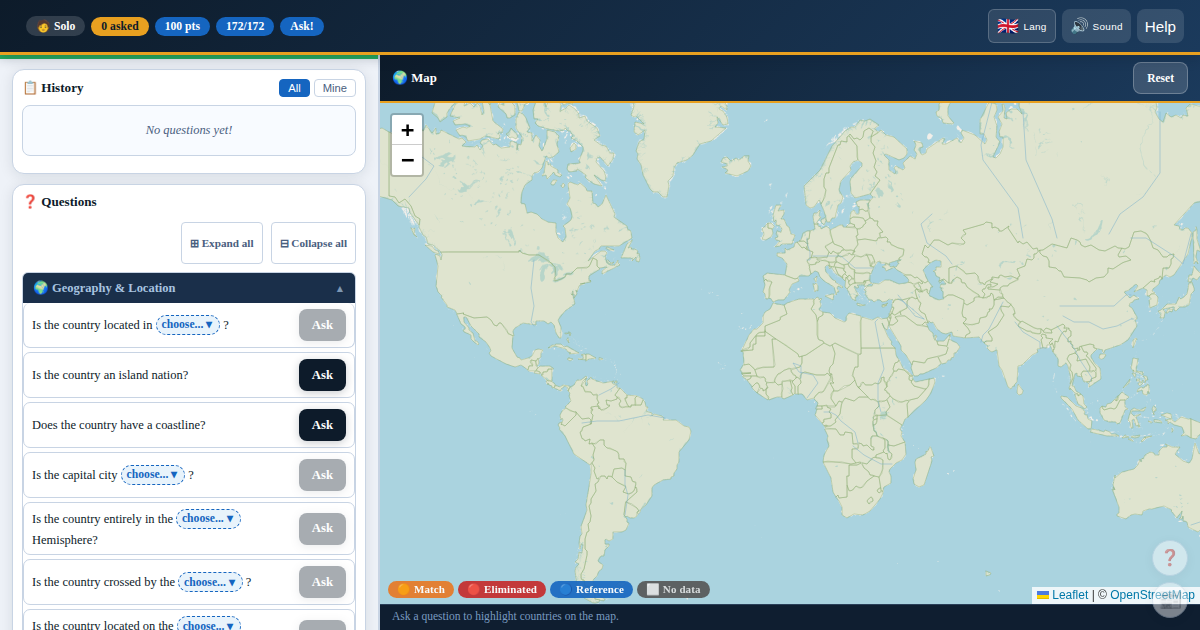
There are 195 recognized countries in the world. How many do you really know? Not just the name — but the capital, continent, neighboring countries, language, history? Geography quizzes are one of the most effective ways to anchor this knowledge, because they transform passive memorization into active engagement.
Why Geography Quizzes Work
The cognitive science research is clear: the testing effect shows we retain information better when we've had to retrieve it from memory than when we've simply read it. A world countries quiz forces that retrieval — and each mistake leaves a more lasting impression than passive reading.
The best geography quizzes don't just test: they teach. When you discover that Japan is the only major island economy in the G20, or that France is simultaneously a permanent UN Security Council member and an EU member, those connections anchor naturally.
The Most Effective Types of Geography Questions
Location Questions
"Which continent is Ethiopia in?" — The most basic level. Useful for beginners, but insufficient alone.
Relationship Questions
"Does the Amazon River flow through Brazil?" — Forces understanding of connections between countries and geographic features. Brazil isn't just a country in South America — it's the country where the world's largest river by volume begins.
Progressive Elimination Questions
"The country is in Asia, landlocked, and on the Silk Road — which one?" — This cumulative reasoning, used in Geo-Atlas's GeoElimination mode, is particularly powerful because it simulates real geographic thinking rather than simple memory retrieval.
Comparison Questions
"Which is the largest country in Africa?" — Creates relative landmarks rather than isolated facts.
7 Key Countries for Understanding World Geography
Knowing these 7 countries well provides a solid framework for understanding the rest of the world:
🇫🇷 France — The Country of Many Faces
France is simultaneously an EU member, NATO member, Schengen Area member, and permanent UN Security Council member. It borders 8 countries in metropolitan Europe and has territories on every continent. It's one of the few countries crossed by two major rivers: the Seine and the Rhine (through Alsace).
🇧🇷 Brazil — The Silent Giant
Brazil is the only Portuguese-speaking country in the Americas and the world's 5th largest by area. It borders 10 of the other 13 South American countries. The Amazon flowing through it accounts for 20% of the world's freshwater discharge into oceans. A BRICS and G20 member, Brazil is also part of MERCOSUR.
🇯🇵 Japan — The Unique Archipelago
Japan is an island nation in the G20 with a GDP per capita exceeding $30,000. It has never been colonized and uses three distinct writing systems simultaneously. Japan is the only country to have experienced an atomic bombing and rebuilt itself into one of the world's top economies.
🇩🇪 Germany — The Heart of Europe
Germany borders 9 countries — more than any other European nation. Both the Danube and the Rhine flow through it. A founding EU member, NATO member, Schengen Area member, and permanent G20 participant. Its 1990 reunification was one of the most significant geopolitical events of the 20th century.
🇪🇬 Egypt — The Link Between Two Worlds
Egypt is geographically in North Africa but culturally and politically anchored in the Arab world. The Nile — the world's longest river — flows through it from south to north. It borders both Africa (Libya, Sudan) and Asia (Israel, Gaza) and controls the Suez Canal, a strategic global maritime passage.
🇰🇿 Kazakhstan — The Largest Landlocked Country
Kazakhstan is the world's largest landlocked country — no sea access, yet bordering the Caspian Sea. A former Soviet republic, it's the world's 9th largest country by area. Predominantly Muslim, it joined the BRICS in 2023.
🇰🇪 Kenya — East Africa's Crossroads
Kenya is crossed by the equator, giving it diverse climates from the arid north to the tropical south. It borders 5 East African countries and is a Commonwealth member. Nairobi is sub-Saharan Africa's economic and tech hub.
How to Progress with Geography Quizzes
Step 1 — Continents and major regions: before individual countries, master the 6 continents and their sub-regions (East Africa, Southeast Asia, Scandinavia, etc.).
Step 2 — Countries by characteristics: learn them in logical groups — landlocked countries, island nations, EU members — rather than alphabetically.
Step 3 — Connections: link countries to their rivers, neighbors, colonial history. An isolated fact gets forgotten; a network of connections stays.
Step 4 — Daily practice: 10 minutes per day beats one hour per week. The GeoElimination daily challenge is designed precisely for this — a new country revealed each day through progressive clues on an interactive map.
Geography isn't a list to memorize. It's a living network of connections between peoples, languages, rivers, borders, and histories. Interactive quizzes — especially those using a visual map — make this network accessible to everyone.